

 Current position > Product detail
『Working principle of float flowmeter』Related information(clamp on meter|electromagnetic meter|venturi meterrotameter|orifice meter|ultrasonic flow meter|mass flow meter|coriolis mass flow meter|coriolis flow meter|magnetic flow meter|magmeter flow meter|magflow flow meter|mag meter flow meter|electromagnetic flow meter|vortex flow meter|turbine flow meter|thermal mass flow meter|thermal flow meter|rotameter flow meter)
What are the common types of flow meters (with applicable scope)? The common types and applications of flow meters are as follows: Electromagnetic flow meters work based on Faradays law of electromagnetic induction. Scope of application: Mainly used in sewage treatment. Working principle of elliptical gear flowmeter: When the measured liquid enters the flowmeter through the pipeline, the pressure difference generated at the inlet and outlet drives a pair of gears to rotate continuously, continuously conveying the liquid measured by the initial lunar cavity to the outlet. The product of the number of revolutions of the elliptical gear and four times the displacement per time is the total flow rate of the measured liquid. Scope of application: Suitable for flow measurement work in industrial sectors such as chemical, petroleum, pharmaceutical, power, metallurgy, and food. Working principle of a rotary flowmeter (float flowmeter): In a vertical conical tube that expands from bottom to top, the gravity of the circular cross-section float is supported by liquid dynamics, and the float can freely rise and fall inside the conical tube. Under the action of flow velocity and buoyancy, it moves up and down, and after balancing with the weight of the float, it is transmitted through magnetic coupling to indicate the flow rate on the dial. Scope of application: Suitable for departments such as chemical, petroleum, light industry, medicine, environmental protection, food and metrology testing, scientific research, etc., to measure the flow rate of single-phase non pulsating fluids. The working principle of vortex flowmeter is to measure the flow rate based on the principle of fluid oscillation. Job characteristics: The structure 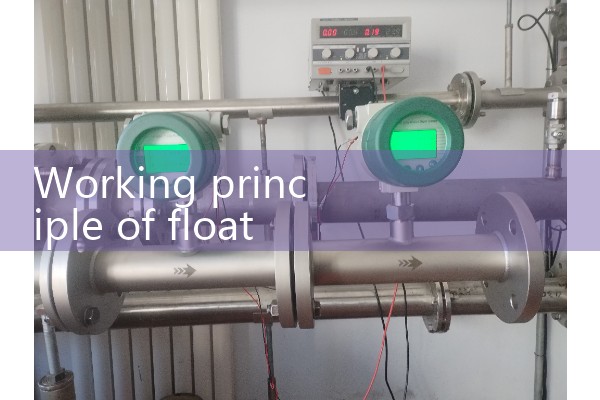
2. Working principle of float flowmeter
A float flowmeter is a volumetric flow meter that measures the flow area between a vertical conical tube by changing the flow area of the float as it rises and falls with the flow rate. It is also known as