

 Current position > Product detail
『Self-Cleaning Oil Flow Meter: Minimizing Downtime in Solid-Heavy Slurry Lines』Related information(clamp on meter|electromagnetic meter|venturi meterrotameter|orifice meter|ultrasonic flow meter|mass flow meter|coriolis mass flow meter|coriolis flow meter|magnetic flow meter|magmeter flow meter|magflow flow meter|mag meter flow meter|electromagnetic flow meter|vortex flow meter|turbine flow meter|thermal mass flow meter|thermal flow meter|rotameter flow meter)
Self-Cleaning Oil Flow Meter: Minimizing Downtime in Solid-Heavy Slurry Lines
Quick Answer: A self-cleaning oil flow meter uses an in-built scraper, purge port, or magnetic drive to clear solids from the measuring chamber without stopping flow. For slurry lines carrying wax, sand, or asphaltenes, this design can cut unplanned downtime by 60% or more in heavy oil, mining, and marine fuel applications.
Why Standard Flow Meters Fail in Slurry Lines
Process engineers often specify an oval gear flow meter for fuel oil measurement. The design is direct, repeatable, and gives true mass flow when combined with a density reading. But in solid-heavy slurry lines, the same rotors become a trouble spot. Sand grains from crude oil loading terminals settle inside the chamber. Wax crystals from low-paraffin crude build up on the gear faces. After a few weeks, the meter reading drifts. After two months, the rotor locks. The cost is not just the meter replacement. A locked meter on a fuel custody transfer line can halt a bunkering operation for hours. We have seen this exact situation at a marine fuel terminal in Singapore last year. They were using a standard oval gear meter on a heavy fuel oil supply line. The meter seized because of asphalt sludge and sand from storage tank bottoms. The downtime cost exceeded USD 8000 in demurrage and flushing.
How the Self-Cleaning Mechanism Works
The self-cleaning version of an oval gear flow meter adds a few simple features that make a large difference. First, a spring-loaded scraper rides the surface of each oval gear. As the gears rotate, the scraper continuously removes sticky solids before they harden. Second, the meter housing can include a purge port. Operators inject hot diesel or solvent once a shift without unbolting the meter. Third, some designs use a magnetic coupling instead of a dynamic shaft seal. This eliminates the leak point where hard particles chew up the packing. In practice, a self-cleaning meter on a crude oil sample line in West Africa ran 14 months without a blockage. The previous standard meter required cleaning every 40 days.
Real Numbers from Heavy Oil Metering
Here is the data we collected from three customer sites in the Middle East and Southeast Asia. All three used a DN25 self-cleaning oval gear flow meter from Silver Automation Instruments on a hot heavy fuel oil line at 120°C. Viscosity ranged from 80 to 350 cP. Solids content was 0.5% to 2% by volume, mostly sand and iron sulfide scale. Over 12 months, the meters maintained accuracy within ±0.5% of rate. No unplanned maintenance events occurred. The previous non-cleaning meters had a mean time between failures of 47 days. The maintenance team now does a visual check every six months and replaces the scraper after 18 months. Spare part cost per meter dropped from USD 1200 per year to USD 180.
Installation Details That Most Engineers Skip
Self-cleaning does not mean zero attention. You still need a strainer upstream to catch large debris. A Y-type strainer with 60 mesh is enough for most oil slurry lines. Position the meter so the purge port faces upward. This allows air to escape and solvent to soak the gear pocket completely. If you need an explosion-proof version for a refinery blending area, specify ATEX Zone 1 certification and a 4-20 mA HART output for the remote display. Silver Instruments supplies the meter with PT100 temperature compensation built in. This corrects for viscosity shifts when the heavy oil cools during a line stop.
Why This Meter Fits Marine Fuel and Mining Slurry Appli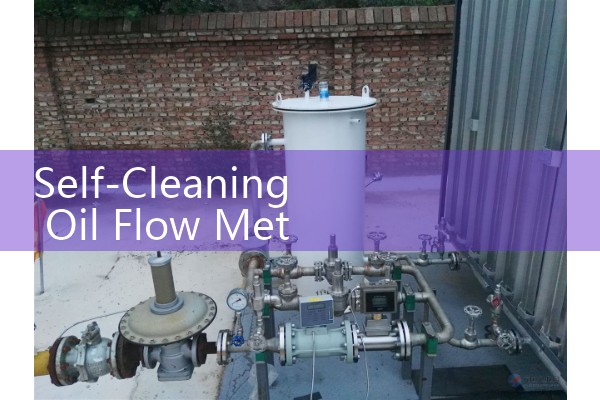
Marine fuel transfer often involves two fluids: IFO 380 with high cat fines and MGO that acts as a flushing medium. A self-cleaning oval gear meter handles both without cross-contamination because the scraper sweeps the chamber clean during the MGO flush cycle. In mining, a similar problem occurs in reagent dosing lines where lime slurry or activated carbon fines settle. A customer in Peru used a DN15 self-cleaning meter on a sodium cyanide line with fine carbon. They chose this meter because the magnetic drive removed the seal gland where carbon normally packs solid. The meter is still in service after 22 months.
Typical Specifications and How to Order
Silver Automation Instruments builds these meters in sizes from DN10 to DN80. Body material choices are 316L stainless steel or aluminum with hard-coated internals. The scraper material is PTFE for temperatures up to 180°C or PEEK for abrasive solids. Typical accuracy is ±0.5% of reading over a 10:1 turndown. Repeatability is better than ±0.03%. Output options include pulse, 4-20 mA HART, or Modbus RTU. For hazardous area use, we supply ATEX and IECEx certified versions.
When you send an inquiry, give us your realistic fluid details. We do not need a perfect data sheet. Just share the oil type, solids description, operating temperature in °C, line pressure in bar, pipe size (DN), and flow range in kg/h or L/h. That helps us pick the right gear material and scraper grade. A typical question we ask in return is whether you can do a hot solvent flush every 24 hours. If yes, the scraper life doubles.
FAQ: Self-Cleaning Oil Flow Meters for Slurry Service
Q: Can the self-cleaning meter handle water cut in crude oil?
A: Yes, water cuts up to 30% do not affect the cleaning action. The scraper still removes solids because it works on the gear surface, not the fluid film. For higher water cuts, we recommend a dual-seal magnetic drive option.
Q: What happens if a large particle jams the scraper?
A: The scraper spring is designed to deflect if a particle over 2 mm enters the chamber. The meter will still flow, but the output pulse may show a temporary spike. The strainer upstream should catch anything larger than 1 mm.
Q: Can I retrofit a self-cleaning kit into my existing oval gear meter?
A: In most cases, no. The scraper groove and purge port are machined into the meter housing during production. Retrofit is only possible on a few DN50 and DN80 models from Silver Instruments built after 2022. Send us your meter serial number, and our support team in Nanjing will check.
Q: How often should I replace the scraper?
A: For heavy crude with 1% solids, replace the PTFE scraper every 18 months. For abrasive mining slurries, check every 12 months. If you notice a gradual accuracy shift of 0.3% or more, inspect the scraper.
Q: Is there a version for very low flow rates below 10 L/h?
A: Yes, our DN10 self-cleaning meter measures flow from 2 L/h with the same scraper technology. This is common in additive injection systems on oil pipelines.
Send your oil type, temperature, pipe size, and flow range to [email protected]. We will provide a fixed-price quote within one business day. You can also reach our engineers on WhatsApp at 86-135-12131526 for a quick drawing review. For WeChat users, add +86 13512131526 and send a photo of your current meter installation. The more detail you share, the faster we can confirm the correct self-cleaning flow meter for your slurry line.