

『Hach Fh950 Handheld Flow Meter Operation: Step-by-Step Flow Tracking in Natural Streams』Related information(clamp on meter|electromagnetic meter|venturi meterrotameter|orifice meter|ultrasonic flow meter|mass flow meter|coriolis mass flow meter|coriolis flow meter|magnetic flow meter|magmeter flow meter|magflow flow meter|mag meter flow meter|electromagnetic flow meter|vortex flow meter|turbine flow meter|thermal mass flow meter|thermal flow meter|rotameter flow meter)
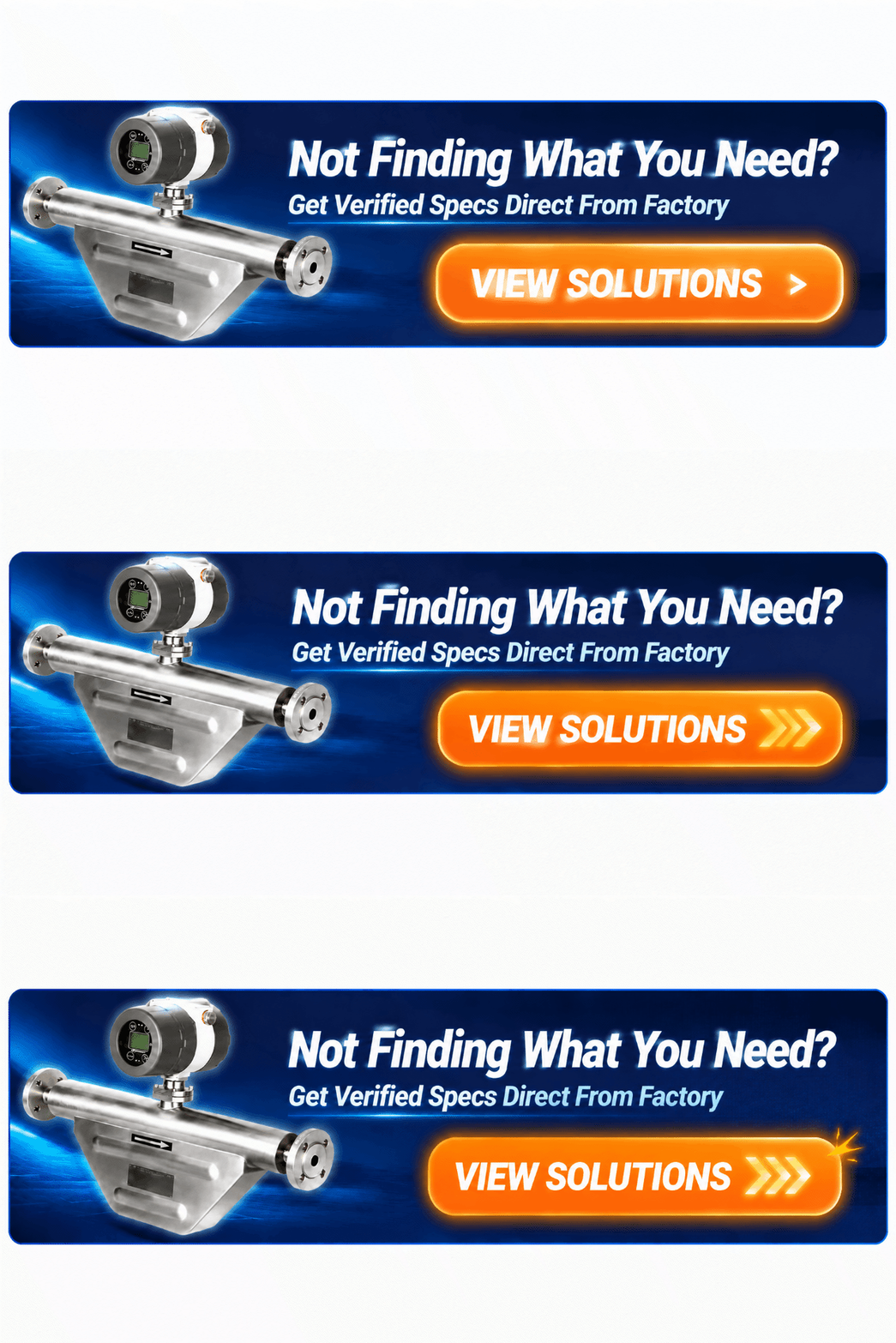
Hach FH950 Handheld Flow Meter Operation: Step-by-Step Flow Tracking in Natural Streams
Quick Answer: Hach FH950 handheld flow meter operation in natural streams uses the velocity-area method. Divide the stream width into vertical stations, record water depth, measure velocity at 0.6 depth or at 0.2 and 0.8 depth, and let the meter calculate discharge. For closed pipe flow meters, Silver Automation Instruments recommends electromagnetic or vortex flow meters based on pressure, temperature, pipe size, and flow range.
Why Natural Stream Flow Tracking Needs a Repeatable Method
Natural stream discharge changes with rainfall, erosion, weed growth, and irrigation return flow. A repeatable measurement procedure keeps data comparable across different days and field crews. In practice, crews in Southeast Asia and northern Australia often underestimate how much cross section selection affects the final flow value.
What You Need Before You Start
The FH950 kit normally includes a handheld display, a probe, a wading rod, a cable, and a battery pack. Before going to the field, check the probe signal, battery charge, clock settings, and logger memory. Most engineers skip the battery check and then lose one hour of travel time. Water temperature and conductivity do not stop the velocity measurement, but high sediment or floating debris can affect the signal.
Have a field sheet ready. Record station number, water depth, velocity reading, signal-to-noise ratio, and measurement time. If you work in remote areas of Peru or the Philippines, use a phone camera to photograph the cross section. This helps with later QA review.
Step 1: Mark a Straight Cross Section
Choose a straight reach with stable banks and minimal eddies. Avoid bridge piers, tributary mixing zones, and backwater areas. Place a measuring tape across the stream. The tape is your station reference. Tension the tape so it does not sag into the water. A cross section that curves or includes a large pool will produce discharge errors.
Step 2: Set Station Spacing and Water Depth
The station spacing must capture the stream bed shape. A practical rule is 10 to 20 verticals across the width. For small streams under 5 m wide, use 10 to 15 stations. For wider channels, add more stations. Do not use the same spacing for every stream. The spacing depends on the bed profile and the velocity distribution.
At each station, lower the wading rod until the probe enters the water. Record total water depth. The FH950 needs the depth value to apply the correct velocity averaging method.
Step 3: Mount the FH950 Sensor Correctly
Fix the probe on the wading rod with the sensor facing upstream. The probe must be parallel to the flow direction. A tilted sensor will bias the measured velocity. In shallow water under 0.75 m, the sensor may sit too close to the surface. In that case, use the 0.6 depth method and keep the sensor at 60 percent of the water depth from the surface.
Step 4: Measure Velocity at Each Vertical
For water depth less than 0.75 m, measure velocity at 0.6 depth from the water surface. For deeper water, measure at 0.2 and 0.8 depth and use the average. The FH950 display prompts you to enter the depth and calculates the vertical mean velocity. Wait for the reading to stabilize. In turbulent flow, velocity can fluctuate more than 10 percent. Let the meter collect a short time average of 20 to 40
Here is the thing. Field crews sometimes move the rod too early. The display looks stable but the sensor is still recovering from rod movement. Hold the rod still for at least 5 seconds before recording.
Step 5: Review Discharge and Export Data
The FH950 software can display total discharge after the last station. Check the sum of station widths and depths against the measured cross section. If the total discharge does not match your expected range, repeat one or two velocity readings. Export the file as a CSV or text file. Keep a backup copy on a field laptop. A water resources office in Queensland lost one month of discharge data because the file was not exported before the battery was replaced.
Common Field Errors in Natural Stream Flow Tracking
Vegetation in the water creates drag and changes the velocity profile. If you must measure near weeds, note this in the file. High sediment can increase acoustic noise. If the signal-to-noise ratio is low, wait for sediment to settle or move to a clearer reach. Wind can push surface water and affect shallow readings. In practice, wind above 15 km/h is a problem on exposed rivers. If the stream is too shallow for the probe, a surface velocity radar may be a better choice.
Silver Instruments Notes for Flow Meter Buyers
Silver Automation Instruments does not sell the Hach FH950. We manufacture industrial flow meters for closed pipe systems. If your natural stream monitoring project also needs electromagnetic flow meters, vortex flow meters, pressure transmitters, or paperless recorders for pump stations, we can support that part of the scope. A common setup is a pressure transmitter for water level with a 4-20 mA HART output plus a paperless recorder for data logging.
For a quotation, send us your pressure (bar), temperature (°C), pipe size (DN), and flow range. Tell us the fluid type and whether you need 4-20 mA HART or Modbus output. We will recommend an electromagnetic or vortex flow meter based on those values.
Contact Silver Automation Instruments:
Tel: +86-25-68650347
Whatsapp: +86-25-52155837
WeChat: +86 15365082610
FAQ: Hach FH950 Handheld Flow Meter Operation
What does the FH950 measure in a natural stream?
It measures point velocity and calculates discharge using the velocity-area method. You enter water depth and station width, and the meter computes flow in m3/s or L/s.
How many vertical stations should I use?
Use 10 to 20 verticals for most natural streams. Narrow the spacing where the bed changes sharply. This keeps discharge error under control.
When should I use the two point velocity method?
Use the two point method at 0.2 and 0.8 depth when water depth is greater than 0.75 m. For shallower water, use the single point at 0.6 depth.
Can the FH950 work in high sediment water?
High sediment can reduce the acoustic signal quality. The meter may still read if the signal-to-noise ratio is acceptable. If the reading is unstable, move to a clearer section or wait for sediment to settle.
What if my stream is too shallow for a wading rod?
A handheld acoustic Doppler meter may not be practical. You can use a surface velocity radar or a small flume. Silver Instruments can advise on pipe flow meters if the stream is diverted through a closed pipe.
 Hot Blog
 Related AD